Buy vs. Build: What Actually Costs Less in Year One
Should you build custom software from scratch or start with a proven product? Compare the real costs, timelines, risks, and year-one savings before you decide.

In this article5 sections
Key takeaway
If you're a founder or business owner trying to digitize your operations — a booking system, an inventory tool, a customer app — you'll eventually hit the same fork in the road every growing business hits: do we build this from scratch, or start from something proven?
Most agencies will quote you a custom build without ever mentioning the real cost of "custom." This article breaks down where that time and money actually goes, so you can make the decision with real numbers instead of a sales pitch.
The custom build quote you're probably getting
A typical custom software quote for a mid-complexity business tool (think: a clinic management system, a booking platform, or a logistics dashboard) in India today looks something like this:
- Discovery & requirements gathering: 2–4 weeks
- Design (UI/UX): 3–5 weeks
- Development: 10–18 weeks
- Testing & QA: 2–4 weeks
- Deployment & handover: 1–2 weeks
Total: 4–6 months, ₹8L–₹18L, depending on scope and the agency's rates.
And that's the optimistic timeline. Requirement changes, scope creep, and the inevitable "wait, we also need this" conversation routinely push custom builds 30–50% past their original estimate — in both time and cost.
Where that money actually goes
It's worth understanding what you're paying for, because most of it isn't unique to your business:
- 1Reinventing standard functionality — login systems, admin dashboards, payment integrations, notification systems. These exist in nearly every business software product ever built, but a custom build charges you to build them from zero, every time.
- 1Design exploration — figuring out layouts, color systems, and user flows that have already been solved thousands of times for common business categories (appointment booking, POS, CRM, etc.).
- 1Bug discovery — a brand-new codebase has bugs a battle-tested one has already found and fixed. You're paying to discover problems that a proven product has already solved.
- 1Project management overhead — coordinating a multi-month build adds real cost that has nothing to do with your actual features.
None of this means custom development is a bad choice — for genuinely novel products, it's the only choice. But for the 70–80% of business software needs that are common patterns (booking, inventory, CRM, payroll, delivery tracking), you're often paying full custom-build prices for something that's fundamentally not custom.
The alternative: proven foundation + targeted customization
The middle path — and the one we built Techbrond around — is starting from a proven, working product and customizing the 20–30% that's actually unique to your business.
Here's what that changes:
Custom build Timeline: 4–6 months Cost: ₹8L–₹18L Risk: Untested code at launch Source code ownership: Yes (with the agency) Customization depth: Unlimited
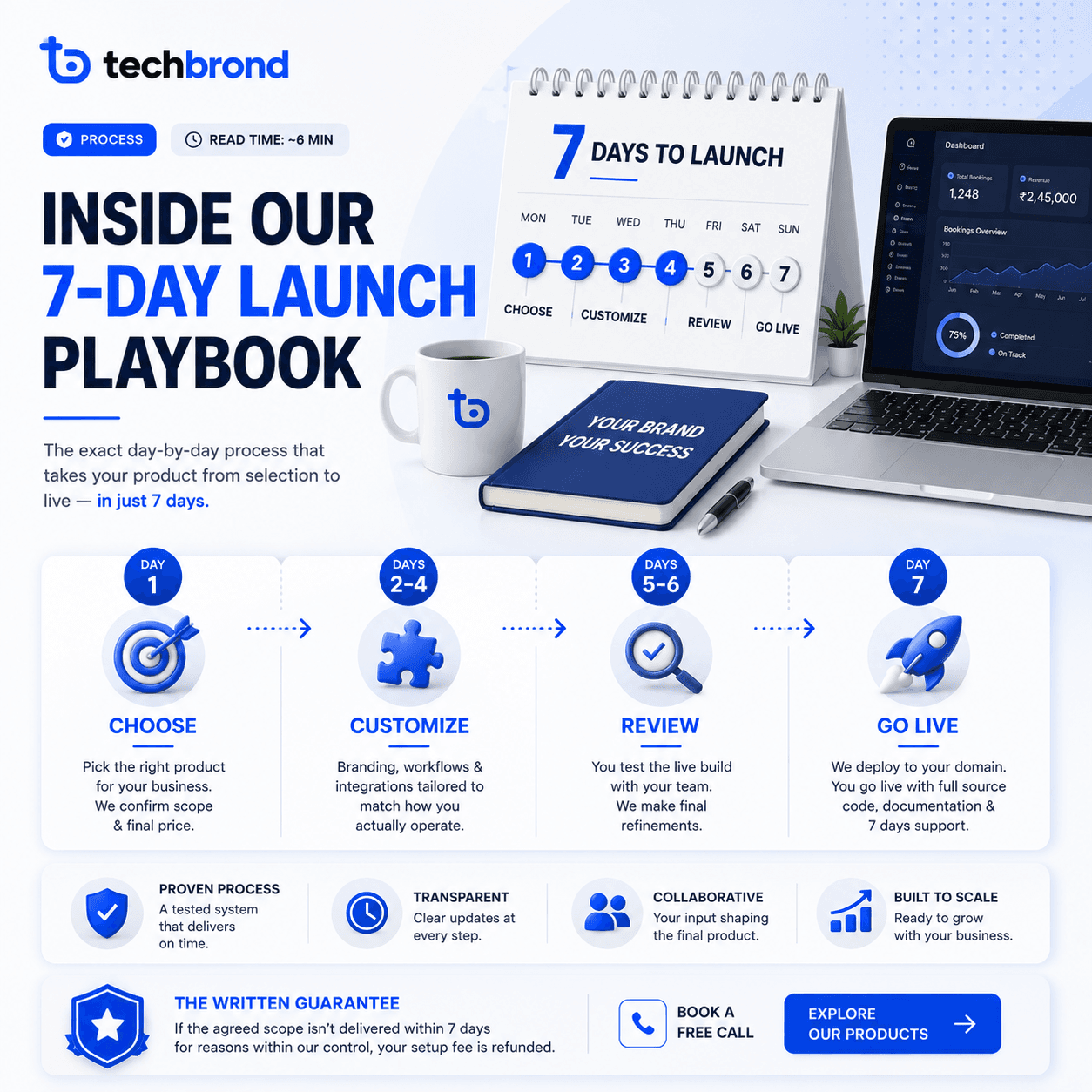
Proven foundation + customization Timeline: 6–9 days Cost: ₹70K–₹1.2L Risk: Foundation already running in production elsewhere Source code ownership: Yes, handed over at launch Customization depth: Deep, but bounded by the product's architecture
The trade-off is honest: if your business genuinely needs something no one has built before, a proven-foundation approach won't fit. But if you're building "a clinic booking system with our specific workflow" rather than "a fundamentally new category of software," you're very likely paying custom-build prices for a solved problem.
How to tell which camp you're in
Ask yourself three questions:
- 1Does a version of this exist for other businesses in my industry? If yes, you're probably looking at a customization problem, not a from-scratch problem.
- 1Is my "unique" requirement really a workflow difference, or a completely new feature category? Workflow differences (different approval steps, different fields, different notifications) are customization. New feature categories (a genuinely novel matching algorithm, a new business model) are custom-build territory.
- 1What's my actual timeline pressure? If you need to be live in weeks, not months, a proven foundation is very likely your only realistic option regardless of the "ideal" architecture decision.
The real year-one cost comparison
When you account for the full picture — not just the build cost, but the opportunity cost of a 4–6 month delay, the cost of production bugs that a proven product has already ironed out, and the ongoing maintenance burden of a bespoke codebase — most businesses find that starting from a proven foundation costs 60–85% less in year one, even before counting the revenue they generate by simply being live months earlier.
The bottom line: custom development isn't wrong, it's just frequently the wrong first move. Start with what's proven, customize what's actually unique to you, and save true custom development for the parts of your business that genuinely have no precedent.
Ready to find your starting point?
Browse ready-made products or discuss a custom build.